Anat Ebgi Tribeca | 372 Broadway | September 9 – October 17, 2026
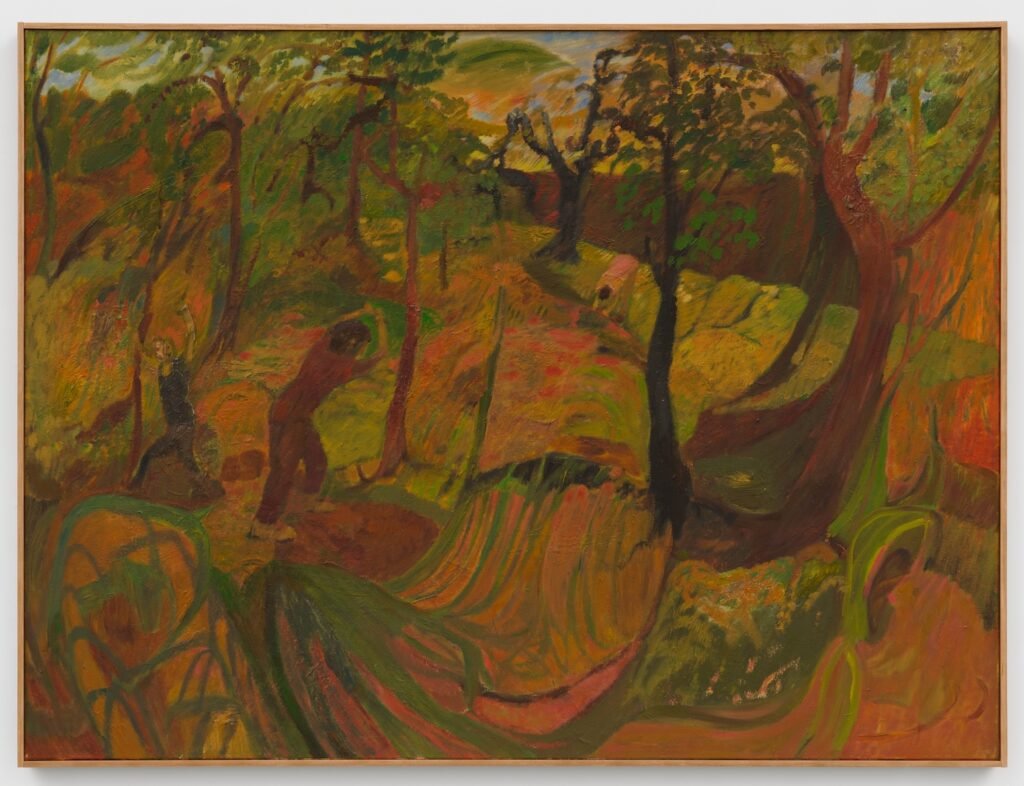
Photo courtesy Anat Ebgi Gallery
Looking at the figures in Soumya Netrabile’s Woodchoppers (2026), laboring in a forest that swirls around and surrounds them, I was reminded of the many depictions of solemn woodcutters by the Barbizon artist Jean-François Millet. But, as I began to realize that these nondescript laborers are the only recognizably human figures in a body of work otherwise teeming with life, my thoughts drifted to Millet’s colleague Théodore Rousseau, that painter of forlorn forests and desolate landscapes. Like Rousseau, Netrabile transforms the details of the natural world into uncanny presences charged with melancholy and unease.
Throughout the oil paintings and ceramic sculptures in Netrabile’s exhibition “Field Conditions,” currently on view at Anat Ebgi, natural forms both familiar and foreign intermingle in surreal configurations. The figures in Woodchoppers (2026), for example, appear at risk of being consumed by an undulating forest floor, while, elsewhere, sprouting seedlings, distant trees, and the toothy mouths of carnivorous plants cohabitate with spectral insects and dissolving foliage. In Unconformity (2026), inchoate life forms, flesh-colored and half-submerged in water, approach one another. As this painting demonstrates, the task of identifying specific flora and fauna in these pictures is an exercise in futility, as real and imagined entities continually blend into one another, a slippage that characterizes Netrabile’s art.
The scenes Netrabile depicts are mirrored by her painting process, both of which are shaped by accumulation and abundance. This visual density is amplified by the artist’s unusual color palette of acid yellows, oxidized ochres and browns, and murky olive and forest greens, a chromatic atmosphere at once toxic and lush. Grass-green brushwork covers the foreground of Mountain Storm (2026) like overgrowth, while the layering and melding of floral motifs across the surface in Sun Eaters and Prairie Syncopation (both 2026) is almost hallucinatory in effect. Though the edge-to-edge patterning in these pictures flattens their spatial depth, other paintings introduce shapes that seem to project outward toward the viewer, like the horn that protrudes from the bottom left of Mountain Storm. Her paintings also accumulate through her revisions, as in The Salt Pool (2026), where traces of imagery scraped away and painted over remain visible. Viewed up close, these pentimenti slow the painting’s tempo, allowing details to perpetually reveal themselves.
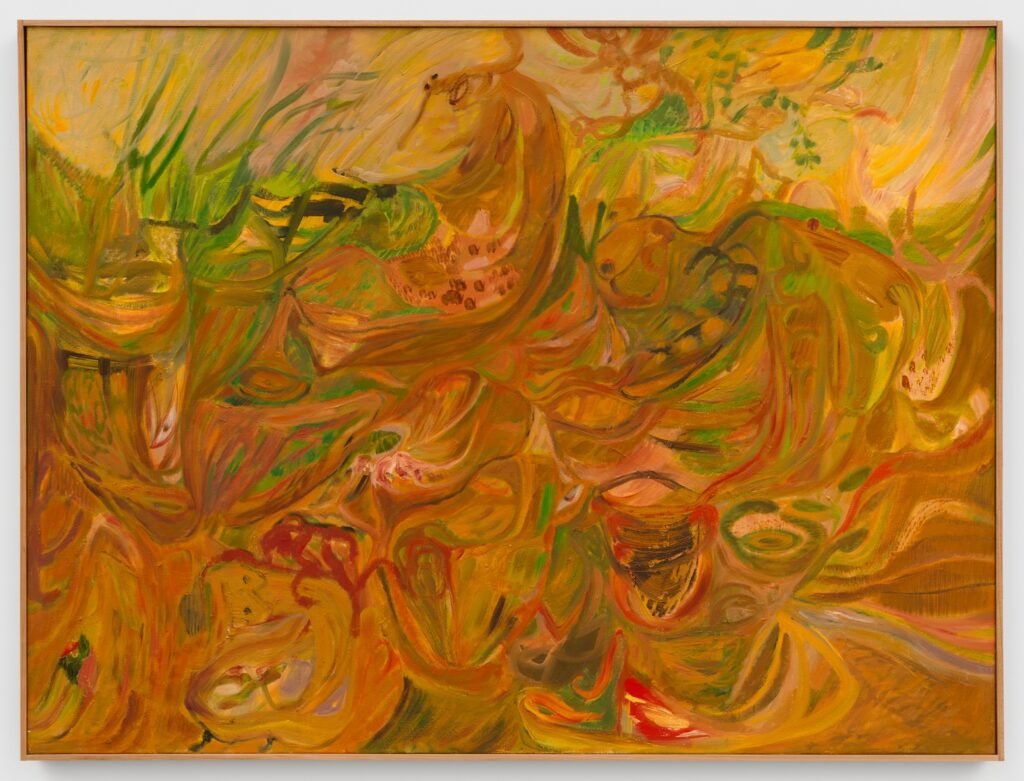
Photo courtesy Anat Ebgi Gallery
Netrabile’s small ceramic sculptures, all dating from 2026 and ranging from twelve to eighteen inches tall, give corporeal form to the organisms that inhabit her paintings, and bring their relation to bodily matter into sharper, more explicit focus. In Two Birds and White Blood, glistening tracts and open cavities evoke entrails and extracted organs, while Half Leg takes on the dry, stripped quality of weathered bone. The contrast between soft tissue and skeletal matter extends to the foundation of Green Goddess, which rests on reptilian limbs, and to Black Skirt, whose surface mimics a mottled hide. Across both mediums, the accumulation of organic matter in Netrabile’s art functions in a destabilizing manner. Like Rousseau’s mournful forests, her imagined landscapes take shape as living systems where growth and decay remain suspended in an uneasy equilibrium.
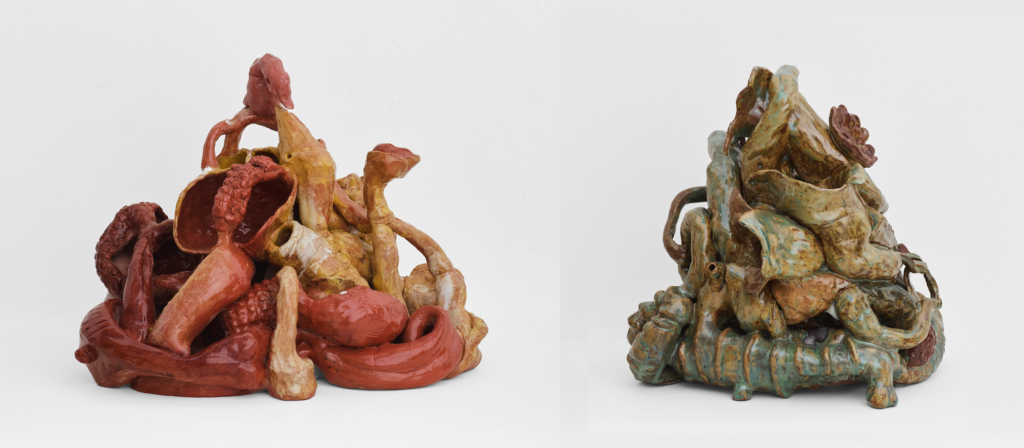
Two Birds, 2026, glazed terracotta, 11 x 14 x 11 inches (left)
and Green Goddess, 2026, glazed stoneware, 12 x 11 x 10 inches (right).
Photos courtesy Anat Ebgi Gallery
